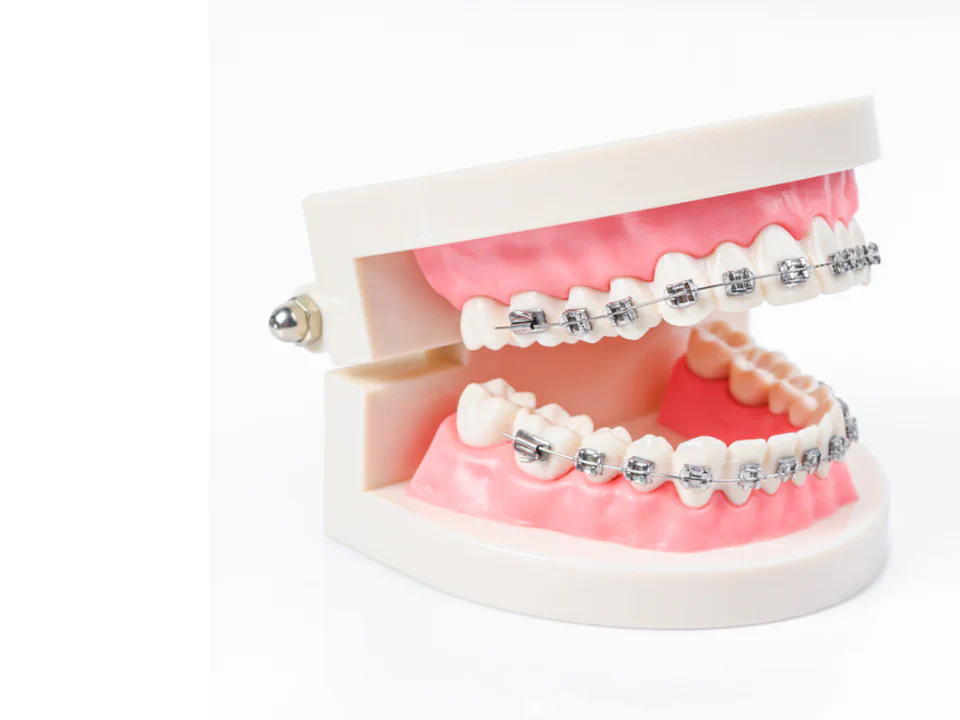
Metal Dental Braces
Traditional metal dental braces are typically used in cases with extreme overcrowding because they move your teeth in small increments at a time and give your dentist or orthodontist more control.
Metal Braces in Victor, NY
All kinds of braces are dental tools that help correct problems with your teeth like crowding, crooked teeth, or misalignment. Metal braces include brackets that are attached to the front of your teeth or bands that fit around each tooth with flexible wires or archwires that hold the bands together.
Some braces also include rubber bands or metal ties that link the brackets to the wire. These bands create more pressure to help straighten and align your teeth.
Sometimes clear brackets and tooth-colored wires can help hide the hardware. our doctors will help you explore the options and discuss if braces fit your treatment scenario.
As part of your treatment plan, we may use a rapid palatal expander (RPE) to help reduce teeth crowding before getting braces. The RPE slowly expands the palate to correct the bite. This stage usually lasts no longer than 18 months.
While orthodontics can solve many tooth alignment problems, successful treatment relies on good patient compliance. Wearing elastic bands consistently, keeping follow-up appointments for adjustments, and practicing outstanding home care can all help lead to a positive outcome. This commitment involves frequent preventive visits with your hygienist. Our team specializes in helping our orthodontic patients through this process so you can enjoy a gorgeous, healthy smile.
Orthodontics with braces involves teeth straightening and jaw alignment, combining beauty and function. Identifying potential problems as a child may allow for easier treatment, but it’s never too late to discuss ways to enhance a smile.
-
Will my child need braces again when they're older? Will my insurance cover a second treatment?
This depends on each individual patient’s situation. Some children do need braces again when they’re older to realign their teeth. However, sometimes expanding the palate is enough to reduce teeth crowding and the teeth will remain straight.
Depending on your insurance coverage, there may be remaining benefits. Many plans offer a lifetime benefit. If you have questions about insurance, reach out to our office and we will be happy to address your concerns.
Financial & Payment Information -
Will my child have braces the entire time or will there be a period where we wait for adult teeth to come in?
Every patient’s treatment plan is different. This will depend on a number of factors, including the age of the patient and their individual treatment plan. It is possible for there to be a gap of time where the patient does not have braces or any appliances.
-
How do I take care of my braces?
There are a few things to keep in mind when maintaining metal dental braces.
- Avoid foods that aren’t braces-friendly such as chewy foods or soft candies that get stuck in the braces and will be hard to clean out of the hardware. Depending on the food, you may need to cut it into smaller pieces to keep it from getting stuck in the braces.
- Brush and floss on a regular basis. This is always important but becomes more important with braces because there are more spaces, crevices, and surfaces for food to get stuck.
- Ensure you keep your regular appointments with your dentist to adjust, manage, and maintain your metal braces.
-
What are the different types of braces?
- Metal/traditional braces: Traditional braces are made of metal. They include brackets that are attached to the front of your teeth or bands that fit around each tooth, as well as flexible wires or archwires that hold the brackets or bands together. Some braces also include rubber bands or metal ties that link the brackets to the wire. These bands create more pressure to help straighten and align your teeth. Sometimes, your orthodontist will have you wear a device called headgear at night. It provides added pressure to help straighten your teeth. You can put it on and take it off.
- Ceramic braces: The brackets in traditional braces are now also made in tooth-colored ceramic, so you don’t notice them as much. They can also be made with stainless steel, clear materials, or gold.
- Lingual braces: The brackets on these braces are attached to the backs of your teeth, facing your tongue. Lingual braces are harder to see.
- Clear aligners: You might also hear them called invisible braces. These are clear plastic trays that fit snugly onto your teeth. They use pressure to gently move your teeth into the correct positions and straighten your smile. You remove the aligners to eat, brush, or floss, but you should keep them in at least 22 hours each day for them to work. The orthodontist may also place tooth-colored attachments onto your teeth to hold the aligners in place.
-
How much do braces cost?
The cost for braces and aligners usually depends on the severity of the problem and the treatment options discussed between you and your dentist. On average, any of these solutions can range from $2,000 – $5,000 or more.
Costs are affected by individual insurance coverage, dental office payment options, etc. So it really is a cost that is unique to you and your family depending on the extent of your dental needs.
-
What age can I get braces?
We recommend the initial evaluation for braces at 7 years old to assess overall dental growth and development. This way, enough permanent teeth have started to grow in to be able to assess your child. Not every 7-year-old needs braces right away! If no treatment is needed for a few years, we will continue to monitor your child regularly to ensure we time the treatment at the perfect moment!
If your child is having issues with chronic mouth breathing or airway concerns, but they’re younger than 7, we recommend an evaluation with one of our
pediatric specialists first. -
I’m getting braces for the first time. What can I expect?
A few hours after the placement of your braces, mild soreness or discomfort when chewing is to be expected. That initial soreness typically lasts about 5-7 days and will absolutely resolve on its own.
How can I minimize the soreness?
- Take Tylenol ideally 1 hour before your braces go on, or within 1 hour after the appointment
- Keep taking Tylenol every 6 hours for the first 2-3 days to minimize the soreness
- Stick with a soft diet for the first week. The pressure from chewing is what makes the achiness worse.
- Use orthodontic wax or OrthoDots (Amazon) to help cover any pokey spots while your cheeks adjust
-
Will my teeth be sore after every appointment?
You may feel mild soreness or pressure for a few days after adjusting your braces and wires. This is normal and typically improves quickly.
What helps:
- Over-the-counter pain medicine (as directed)
- Soft foods
- Orthodontic wax (for braces irritation on your lips or cheeks)
-
What is that blue stuff glued to my back teeth? How long will they be there?
Those are called “bite turbos,” and they prevent your top teeth from biting into your lower braces. These wear down naturally over time, and we will remove them when your teeth move enough not to need them anymore – which is usually after a few months.
-
What do I do if I break a bracket?
If you notice the bracket sliding around the wire, give our office a call, and we will fix it as soon as possible. It is not an after-hours emergency, but to prevent delays in your progress, we want to fix it sooner rather than later.
If the back bracket breaks, it may slide off the wire. As long as it’s comfortable, just call our office, and we’ll schedule an appointment ASAP to put the bracket
back. If the wire is too long, still call our office, but you may want to use wax or try to trim the long wire to make it comfortable. -
What do I do if a wire is poking?
Try placing orthodontic wax over the poking areas. Feel free to call our office if the discomfort continues.
-
My teeth feel loose during my orthodontic treatment! What should I do?
This is to be expected during your orthodontic treatment! Your teeth are actually moving! Just maintain your normal braces-friendly diet. Nothing to worry about.
-
What if I run out of rubber bands?
Swing by our office during business hours, and we can restock your supply anytime! Don’t try to order your own version off the internet, please!
-
What do I do if my expander comes off?
If it’s off on only one side, gently push the loose side around the tooth and stick with a softer diet. Call our office, and we’ll get you in immediately to address it.
If it’s completely out, still give our office a call, and please bring the expander with you to the appointment!
-
What foods should I avoid with my braces?
The general rule of thumb is super sticky things (Jolly Ranchers, Starbursts, caramels) or very hard and crunchy things (ice cubes, nuts, croutons).
We ask you to avoid popcorn so those half-popped kernels don’t break your brackets!
Interested in Metal Braces?
Request an appointment at Victor Smiles today for a consultation or explore our other available dental services.